
Trump’s war on Iran is taking place
What's it like to re-read Baudrillard as bombs fall on Tehran?
In 1991, the French philosopher Jean Baudrillard published three short essays arguing — with a born-poster’s combination of pique and irony — that the Gulf War “did not take place.”
The obvious, immediate response is ??? Hundreds of thousands were killed. Many more displaced. Oil fields, and people, burned. It’s featured in The Big Lebowski. The Gulf War definitely happened!

But Baudrillard wasn’t denying the killing. His argument was more specific:1
One of the two adversaries is a rug salesman, the other an arms salesman: they have neither the same logic nor the same strategy, even though they are both crooks. There is not enough communication between them to enable them to make war upon each other.
What happened in the Gulf, he argued, wasn’t war. It was a spectacle: Hussein was running a “hostage operation” while the US ran a one-sided air campaign.
When it ended, Saddam stayed in power. The US, meanwhile, didn’t just declare victory and leave. It also called on Iraq’s people to overthrow their dictator, then did nothing while Hussein massacred tens of thousands Kurds and Shiites for trying to do just that.
The essays are fun and maddening in roughly equal measure. There’s a stubborn cattiness to them that is refreshing in our era of AI slop and algorithmic homogenization.
And there are times, like when your country is marching into a quagmire for absolutely no coherent — much less good — reason, when it’s a relief to flee reality and hide in hyperreality instead.
So, because I am who I am, I had these essays on my mind lately.2 But as I re-read them, I found something more valuable than mere escapism. I think applying Baudrillard’s framework for analyzing the Gulf War to Trump’s war against Iran provides some real insight.
Because in his way, however self-consciously provocative it was, Baudrillard wasn’t wrong about the Gulf War. He suggested the war was colonial in nature, an attempt to punish a symbol of resistance to the New World Order, not because it was a threat, but because it represented the Other.
I don’t want to give that too much credit. Compared to Baudrillard, I’m more of a believer in individual agency; unlike W. in 2003, I don’t think Poppy in 1991 was desperate for a fight. I could imagine scenarios with less bloodshed.3
But for all the limits of his theory, revisiting Baudrillard still felt valuable — because, on that instinctual level that lurks beneath reason, I think Trump agrees. With his distinctly horrifying glibness, this is how Trump has understood military actions so far, and especially during his second term.
The Gulf War did not take place and Trump’s many second-term bombings have not taken place and his earlier war against Iran did not take place and his war against Venezuela did not take place, either.
The problem, of course, is that a regime-change war against the Islamic Republic of Iran doesn’t lend itself to Trump’s unconsciously postmodern approaches to statecraft.
Iran is not Iraq; the United States is not nearly as powerful as it was in 2003, much less 1991; and the current president is not George HW Bush.
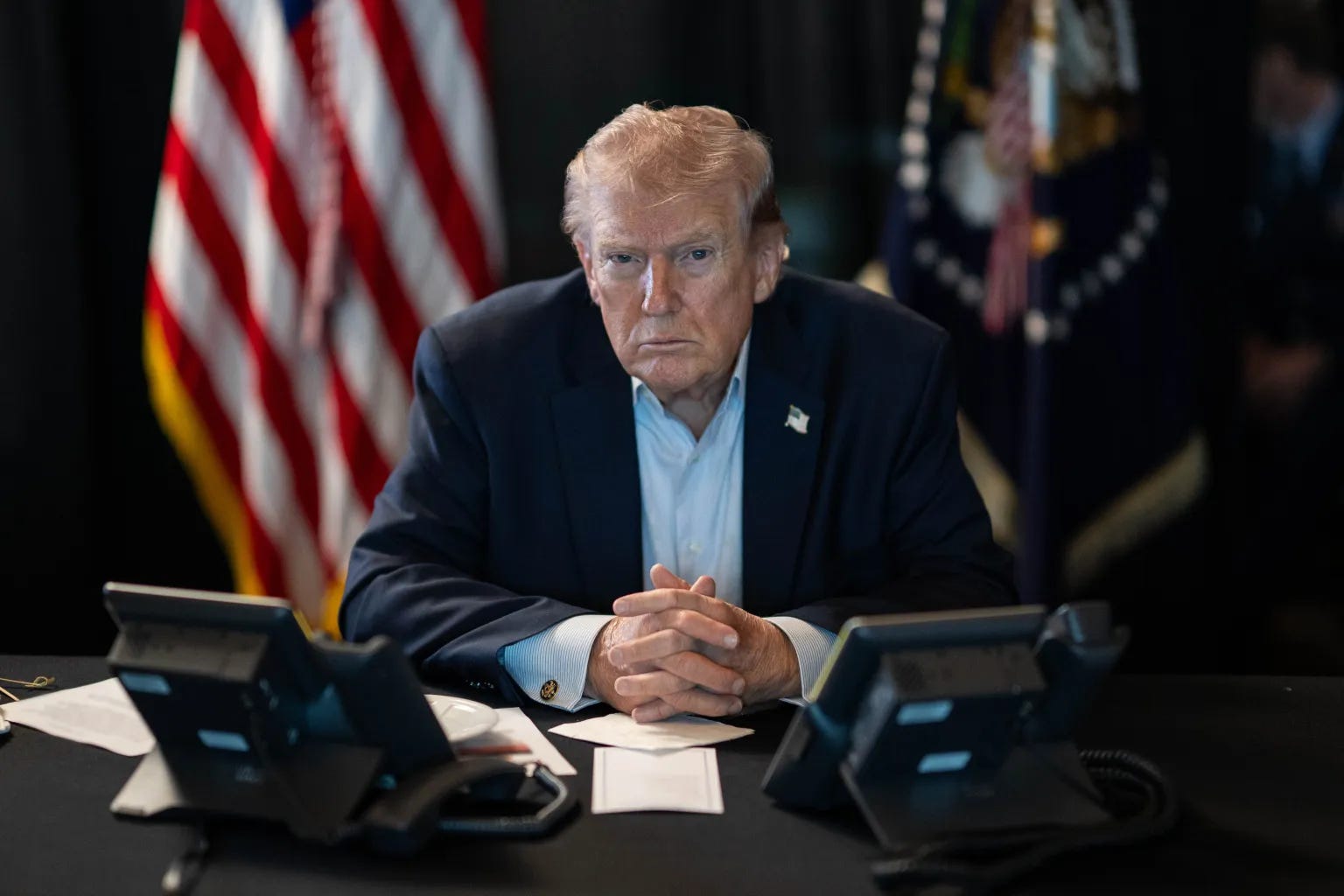
It’s this guy:
This began in Caracas
The operation against Maduro was, in Baudrillard’s terms, almost perfectly unreal.
Maduro was removed from power but government was left intact. He had shown the Godfather disrespect, but his whole crew — that little… thing in Caracas, as Phil Leotardo might say — didn’t have to go. That’d be a whole thing. They just had to make a deal and call it a wash.
Cue the “surgical” strike. Rouse the commandos. Grab Maduro, bring him to a prison in the US, and see if you can still do business with what remains
After having some fun bombing fishermen, Trump got to post, with awe and delight, a picture of one of his enemies defeated and humiliated.
He wasn’t there, of course. But he got to watch it all. Even better, he got to post about what he was watching, too. It’s hard to imagine a more perfect simulacrum of a “war president.”
The experience was so exhilarating, according to The Atlantic, that it gave him some ideas:
The president’s past success with a limited strike on Iran’s nuclear facilities over the summer, as well as last month’s operation that removed Nicolás Maduro from power in Venezuela, may have convinced Trump that the U.S. military is ‘an almost biblical force that can accomplish anything,’ one Trump adviser told us.
Now, you may think, ah, that’s just one report; and it’s someone else’s read on Trump’s mindset, not something from Trump himself. And you’d have a point!
Unfortunately, this is what Trump recently said to Jonathan Karl of ABC News:
President Donald Trump told ABC News’ Jonathan Karl on Thursday that he isn’t concerned about what comes next after the war with Iran, praising what he described as the success of the U.S. military operation.
“Forget about next,” he replied to a question about the future of Iran, Karl reported on X. “They are decimated for a 10-year period before they could build it back.”
Karl also reported that Trump referred to the ongoing Middle East conflict as a “performance,” saying, “I hope you are impressed … How do you like the performance? I mean, Venezuela is obvious. This might be even better. How do you like the performance?”
For lack of a more coherent way to respond to such a stunning quote from the president of the United States about a war of choice he’s launched against a nation of over 90 million people, I’ll take a beat to remind you of this:
Trump has said in interviews and at rallies that two of his favorite movies are the black-and-white classics about stars collapsing in on themselves, “Citizen Kane” and “Sunset Boulevard.”
The problem for President Norma Desmond isn’t that his military got small. It’s that his ambition got too big.
An inconvenient truth: Iran is not Venezuela
There’s a dark irony in all of this that Baudrillard would have appreciated.
His essays were a provocation: if a war is pure spectacle, does it “take place” at all? But he couldn’t quite imagine the inverse problem: a president who actually believed him. Who went looking for a war that would not take place and found one that would.
Because here is what “taking place” means, in practice.
It means oil prices that working people feel at the pump, in a country where inflation was already the issue that cost the previous president his job.
It means US partners in the region who no longer know what American commitments are worth, and who are making their own calculations accordingly.
It means soldiers and sailors in harm’s way, in a war that was started without a public case being made for it, without Congress being consulted, and without anyone in the administration, it appears, knowing what the hell would happen next.
It means Iranians dying. Which includes the regime’s brutal and unlamented leaders, yes; but also the millions of Iranians who did not choose this and cannot stop it.
It also means — and this is the part they actually care about —that gas prices are going (do your best David Byrne here) up-up-up-up, up-up-up-up!
President Donald Trump’s chief of staff, Susie Wiles, is telling his advisers to bring ideas to the Oval Office to lower gasoline prices in the wake of the U.S. attack on Iran, according to two energy industry executives familiar with the conversations.
The White House is “looking under every rock for ideas on improving energy prices, especially gasoline prices,” said one of the executives, who was granted anonymity to describe internal administration discussions.
The attack and Iran’s subsequent targeting of the Persian Gulf’s energy sector has sent crude oil up more than $10 a barrel, lifting gasoline prices to their highest levels since Trump took office last year.
Energy Secretary Chris Wright and other advisers focused on energy policy, including a council led by Interior Secretary Doug Burgum, “are getting screamed at to find some good news” on bringing down prices, the same executive said. “Folks are scrambling for announcements and messaging to counter the narrative” of rising prices, this person said.
None of that fits in a victory video, no matter how many totally badass clips from movies and video games you include. And none of it can be resolved by having your press secretary announce that you’ve decided you’ve won:
Trump has launched a war of choice against a government that has been preparing for exactly this confrontation for nearly half a century.
Also inconvenient: the Ayatollahs ≠ Saddam Hussein
Whatever you think of the regime in Iran — and there is not much to recommend it — the violent men running the Islamic Republic of Iran are not confused about what is happening to them or what they’re going to do about it.
Here’s their plan, according to a report in the New Yorker:
A war of attrition that exhausts missile defense inventories is the most beneficial outcome for Tehran. Iran knows this is a war it cannot ‘win’ militarily, but the regime in Tehran may believe they can survive it.
And here it is again from the regime itself:
We had no choice but to escalate and start a big fire so everyone would see. When our red lines were crossed in violation of all international laws, we could no longer adhere to the rules of the game.
Trump, apparently, expected to find an Iranian equivalent of Delcy Rodriguez; or for the Iranian people to “respond” to the “moment” to “seize control of [their] destiny”; or he’s waiting for some based Kurdish militiamen to save him like he’s Charlie Wilson; or he’s about to bring “certain death” to “groups of people that were not considered for targeting until this moment in time.”
Instead, it seems, he’s traded one Khamenei for another.
And the unlike the version of Saddam Hussein in Baudrillard’s story, the regime in Iran has no intention of trading “[a] perfect semblance of victory” for a “perfect semblance of defeat[.]”
That gives Iran agency — the very agency Baudrillard, and apparently Trump, believed was impossible in an era of hyperreality; or, as others call it, God help us, “performance.”
And also definitely problematic, at the least. He’s trying to be funny but the whole “rug salesman” thing is more than a little Orientalist — a recurring flaw in these essays. The ‘90s were a different time!
In my defense, who could be more out of Baudrillardian than our first reality-TV president — who is also, just by the way, an instinctual fascist?
And there are certainly few among us in the US who prefer 2003 to 1991 when it comes to our wars against Saddam Hussein.