
Should Democrats welcome a weaker Supreme Court?
Dems are in a “Cicero moment,” and their best way out requires a mind-shift.
There’s a passage in a recent Axios piece on the Democrats’ looming identity crisis that stops just short of saying something true.
Jim Messina, who ran Obama’s 2012 campaign, argues that Democrats can’t win a presidential election on opposition alone. The 2026 midterms, he says, will be decided by anti-Trump sentiment, which won’t work in 2028.1
David Plouffe says much the same.
Both men have the diagnosis right, and Plouffe's prescriptions are admirably concrete: a cost-of-living agenda, a jobs program, AI accountability, anti-corruption.
But even the most ambitious policy program is still a policy program, and the crisis Democrats face is constitutional, not programmatic.
Perspective is a hell of a thing. What looks, from one angle, like a forward-looking agenda looks, from another, like a restoration project: a promise to return to an era when American politics was (relatively) competent and humane…
And ultimately defenseless.
What I mean by a “Cicero moment”
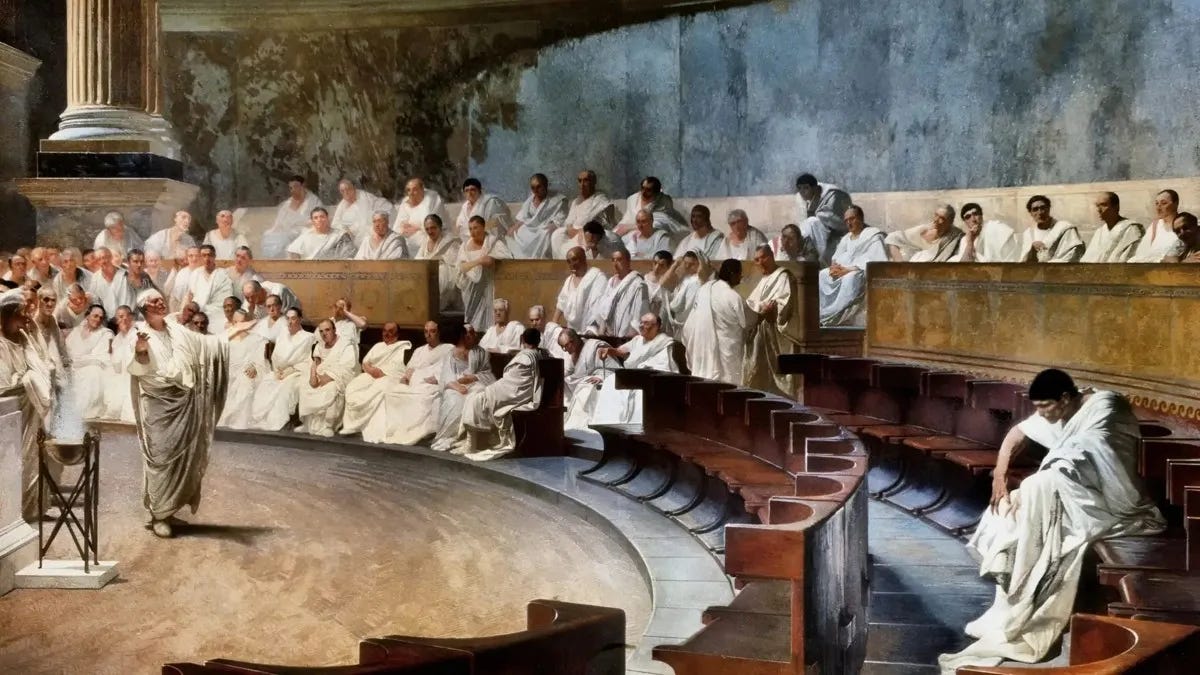
I recently read Anthony Everitt’s Cicero: The Life and Times of Rome’s Greatest Politician; so, let’s be legends,2 and call this a “Cicero moment.”
As depicted by Everitt, Cicero was a tedious egoist and emotional hypochondriac; but he wasn’t stupid and, mostly, he wasn’t a coward.
What Cicero couldn’t do, though, was imagine a version of the Republic that wasn’t run by the Senate. A stronger executive, in his eyes, was tantamount to a republic in name only.
He knew the actually-existing Republic was a “cesspool.” But he had romantic ideas about the Senate and concordia; and even when he was joining Octavian against Mark Antony and Cleopatra, he planned, with delusional vanity, to ultimately reassert the Senate’s power over Caesar’s adopted son.
Less and less, but still, the Democrats’ relationship with the Supreme Court is much the same.
Despite far less genuflecting to the Court than in the days before Justices Kavanaugh and Barrett, Democrats still won’t embrace adding seats to the Court, even — or especially? — at the risk of its legitimacy.
Even if, for defensible reasons I’ll outline shortly, Democrats decide to pass on this fight, the party owes itself an honest debate about “court-packing.”
SCOTUS will not save us
The Supreme Court’s occasional rulings against Trump have given some people — especially people who write columns for struggling newspapers — the impression that it’s protecting the Constitution.
The conservative majority struck down Trump’s tariffs last month.
But the case had nothing to do with popular sovereignty, individual liberty, or the constitutional order. It had nothing to do with the havoc Trump has wrought on the rule of law, the balance of powers, or citizenship itself.
It was a dispute about whether the executive can override Congress on trade policy — which is to say, whether the president can interfere with market forces. The court said no.
Cool, fine, definitely preferable; but it’s not exactly Brown v. Board…
I am being uncharitable. This court and the Court are not the same thing. Brown was real. Obergefell was real. The Warren Court did things that changed people’s lives in ways that still matter.
And within American liberalism, the practice of defending fundamental rights rests on judicial review. That’s a feature, not a bug. I can imagine how Cicero balked.
Still, the Warren Court was the aberration.
For most of its history, the Supreme Court has been a reactionary institution. Today, it’s a threat to democracy itself.
The objection is the argument
The standard case against court-packing is that even if you somehow could do it, Republicans would simply do it back.
You’d be trading a captured court for an openly politicized one — and thus hastening, presumably, the degradation of the body politic.
But what if that argument is not just reductio ad absurdum? What if it’s not quite a goal, exactly, but rather an unfortunate but accepted consequence?
What if Democrats need to accept what Cicero never could — that something fundamental has changed?
Maybe, in this era, protecting the communities and principles that bind the party requires risking a weaker Supreme Court.
The straitjacket
There’s an obvious objection to everything I’ve just argued, and David Plouffe, if he were reading this,3 would probably make it.
Talking openly about court-packing, about the Court’s illegitimacy, about the constitutional order as an obstacle rather than a foundation — swing-voters in North Carolina don’t want to talk about popular sovereignty.
The party is in a kind of constitutional straitjacket. The Senate is structurally designed to give the same weight to Democratic colossi like New York and California that it does Republican Wyoming and South Dakota.
And the party needs a majority to do anything, and a big majority to do big things.
I don’t dismiss that. The constitutional bind is real — and it’s tight.
But Cicero’s problem wasn’t a lack of realism. His problem was that he couldn’t appreciate what Lampedusa’s Tancredi understood.
Sometimes, “If we want things to stay as they are, things will have to change.”
A few weeks into the craziest war in recent American history, we are well past the point of anything staying the same.
If Democrats want this country to stay by, for, and of the people, they should talk amongst themselves — at least — about learning to love a weaker Supreme Court.
I.e., insufferable middle-aged nerds.
Hey, David!
Pack the court, then threaten the GOP with more packing unless they sign off on an amendment limiting further packing.
My point is that the only thing Republicans seem to respect is an equal and opposite force - remember, the NRA literally started writing gun control legislation in the 70s when the Black Panthers started open carrying.