
“Unforgiven” is about an incompetent
“Worse than a crime — a mistake.”
Charles Maurice de Talleyrand-Périgord — remembered, simply, as Talleyrand — was one of the “great” diplomats and statesmen of his era.
He spent years helping Napoleon Bonaparte build his empire, only to eventually betray the Emperor when it became clear to him that the latter’s time was running out. He was cynical to the point of nihilism, a shameless womanizer, and corrupt as hell.
He was also the author of more than a few sterling bon mots. If he had been born a few centuries later, it is likely he would have also been a top-tier, Hall of Fame-level poster.
There are two quotes attributed to him that I particularly enjoy.
The first, which I think about whenever I’m reminded that there’s a whole generation of people who never knew what it was like to live in a world before Instagram, is this:
He who has not lived in the eighteenth century before the [French] Revolution does not know the sweetness of life and cannot imagine that there can be happiness in life.
My second-favorite, however, requires a pinch of context.
For one thing, it turns out that the quote, while often attributed to Talleyrand, was actually said by someone else, although it’s not clear who.
More importantly for my purposes here, though, is that the quote was a response to Napoleon Bonaparte’s decision to have a rival kidnapped and executed.
The move had short-term gains (and Napoleon would go to his death insisting he was right to do it) but many people, then and now, believed the benefits were more than outweighed by long-term costs.
Eventually, somebody described the whole affair as:
Worse than a crime — a mistake.
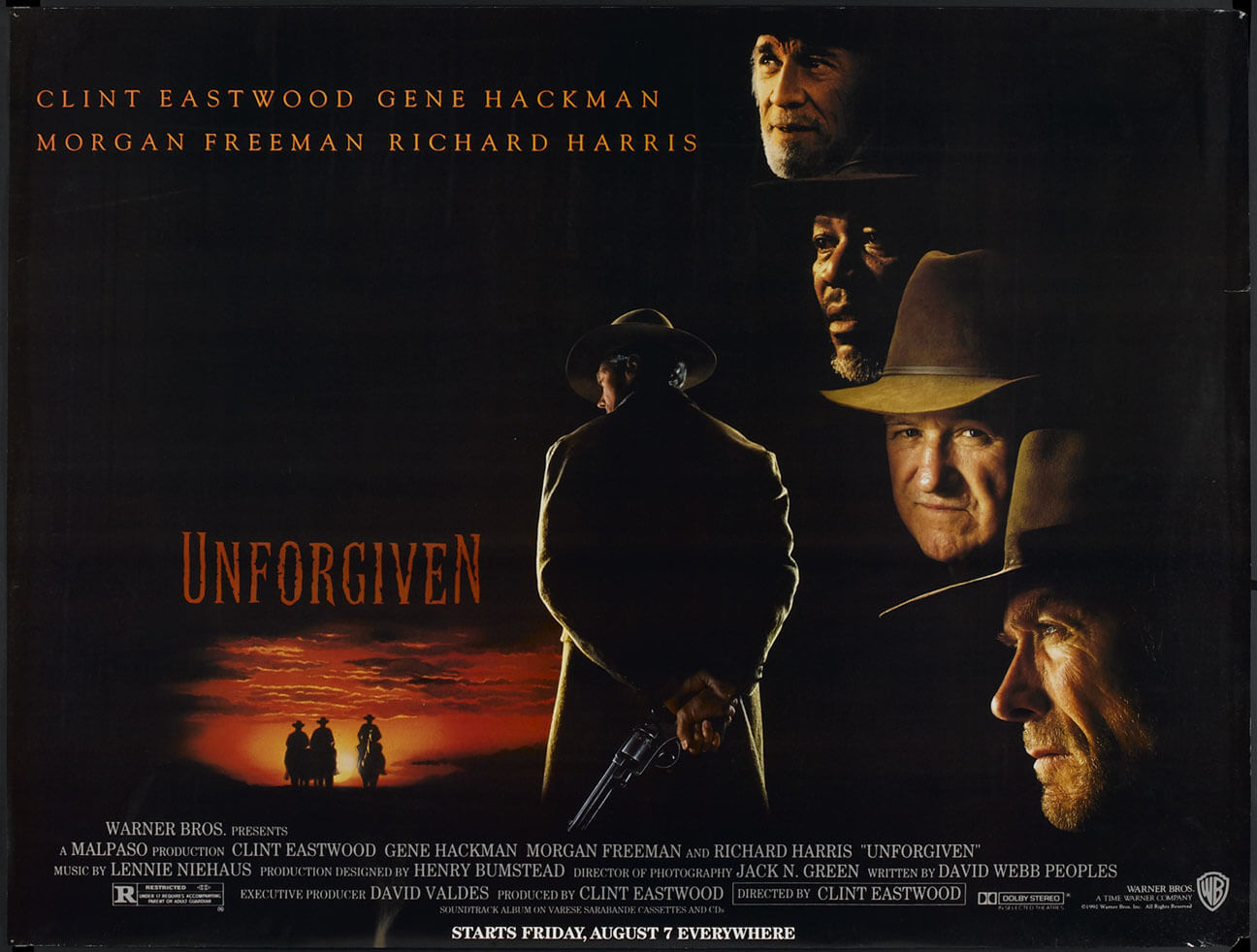
And that is what came to my mind during my recent re-watch of Unforgiven (1992), Clint Eastwood’s masterful revisionist Western about a showdown between two “bad” men who represent incompatible visions of how to create order and justice in a violent, chaotic world.
Like any truly great film, Unforgiven is about a lot of things, and like any great Western, those things include: capitalism, progress, self-mythology, and US history.
What makes Unforgiven especially interesting, however, is that it is interested — on a deep and almost spiritual level — in what philosophers call the question of “desert”, and what normal people call the basic question of whether we get what we deserve.
But as I watched Unforgiven this past weekend, I was struck by how much the film is also about something much simpler: the importance of having a government staffed with serious people who take their jobs seriously. The absolute necessity of basic competence. The value of good bureaucrats.
Because what really sets the plot of Unforgiven into motion is not a crime; it’s a mistake.
Despite being the closest thing the film has to a defender of the rule of law, the man who makes this mistake — Sheriff Little Bill Daggett (Gene Hackman) — is domineering and sadistic. But the source of his error is neither his authoritarianism nor his brutality.
It’s his utter incompetence.
The two Williams
William Munny was once the kind of man other killers invoked like a curse. A drunk, “a killer of women and children,” infamous for savagery that even by the standards of the frontier was considered extreme.
Then he met a woman who seemed to see something in him nobody else did. Married her, got sober, spent eleven years trying to become the pig farmer she apparently believed he could be.
By the time the film begins, she’s dead from smallpox. He’s failing at the farm, face-down in the mud more often than not, but still sober, still trying.
Little Bill Daggett has also reinvented himself. He’s the sheriff of Big Whiskey now, which means he still gets to hit people, but with a badge.
He is building a house, too — literally, with his own hands, badly: one of his deputies calls him the “worst carpenter.”
He can dominate a room, humiliate a man in the street, run a protection racket with the confidence of someone who has never once questioned his own judgment. What he cannot do is build anything that holds.
Whatever order he maintains rests entirely on the threat of violence. He doesn’t cite a law when he demands new arrivals disarm. He cites a hand-painted sign.
Little Bill’s big blunder
There is no such thing as equality under Little Bill’s corrupt facsimile of “the law.” He does not judge people according to what they’ve done. He judges them according to who they are.
After two cowboys are detained in a brothel for viciously assaulting a sex-worker — slashing her repeatedly across the face because she involuntarily laughed at how small one of their penises were — Little Bill is initially inclined to punish via bullwhip.
The plan is hardly a model of restorative justice, but it’s at least consonant with an idea of justice: namely, “an eye for an eye.”
But then Skinny, the brothel’s owner and resident pimp, complains that Little Bill’s plan would leave him at a financial loss:
SKINNY: Little Bill, a whipping ain’t going to settle this. This here is a lawful contract between me and Delilah Fitzgerald, the cut whore. I brought her clear from Boston, I paid her expenses and all, and I’ve got a contract here that represents an investment of capital.
LITTLE BILL: Property.
SKINNY: Damaged property. Like if I was to hamstring one of their cow ponies.
LITTLE BILL: So you figure nobody will want to fuck her now, right?
SKINNY: Hell no, least ways they won’t pay to do it. Maybe she can clean up the place or something, but nobody’s going to pay good money for a cut up whore.
“I guess you’d just as soon not have a trial. No fuss, huh?” Little Bill asks the cowboys. They agree, and a deal is struck: instead of being whipped, they will give Skinny some of their finest ponies — seven of them, which is almost certainly worth more than Delilah’s contract — or else.
The brothel’s madam, Alice, dissents:
ALICE: You ain’t even going to whip them?
LITTLE BILL: Well, fined them instead, Alice.
ALICE: For what they done? Skinny gets some ponies, and that’s it? That ain’t fair, Little Bill. That ain’t fair!
He could have stopped here. The deal was already done, the cowboys spared.
Instead he turns to Alice and explains that they were just “hard-working boys who were foolish” — not like, he doesn’t quite say, the women in this room:
LITTLE BILL: Haven’t you seen enough blood for one night, Huh? Hell, Alice, it ain’t like they were tramps, or loafers or bad men, you know there were just hard working boys who were foolish. If they was given over to wickedness in a regular way then I could see…
ALICE: Like whores?
Alice doesn’t miss it. Neither does the audience.
It did not enhance but rather diminished his authority. And it made a mockery of his already pathetic “system” of order, revealing it to be a rickety and jerry-rigged construction that represents nothing more than his arbitrary will.
Now it is clear to Alice, if it weren’t already, that Little Bill’s sovereignty over Big Whiskey stands — solely — on his use of brute force.
And in the Wild West of 1880, there are plenty of other men who are happy to exchange their violence for someone else’s money.
“What I’m doing is talking.”
Little Bill knows immediately what he’s done. The bounty Alice and the other women put out — pooling their savings, for which Alice is beaten by Skinny — is a direct challenge to his authority. And because that authority rests entirely on force, the only answer he can think of is more force.
English Bob (Richard Harris) comes to Big Whiskey with hopes of an easy score. Like Little Bill, he too has had a late-career shift, becoming muscle for railroad companies trying to keep their Chinese laborers as weak, unorganized, and exploited as possible. Unlike Little Bill, however, he cannot claim that his actions carry with them the imprimatur of the law.
So when Little Bill catches English Bob walking around Big Whiskey with multiple firearms on his person, he decides the best way to shore-up his dwindling authority is to make an example of the man. He disarms him, then sucker-punches him, and then proceeds to brutally beat him in the middle of his little fiefdom’s one main street.
And as he literally — and repeatedly — kicks English Bob while he’s down, Little Bill proclaims:
I guess you think I’m kicking you, Bob. It ain’t so. What I’m doing is talking. You hear? I’m talking to all those villains down there in Kansas! I’m talking to those villains in Missouri! And all those villains down there in Cheyenne! And I’m telling them, there ain’t no whores’ gold! And even if there was, well, they wouldn’t want to come looking for it anyhow!
As far as English Bob goes, the tactic works. Bob is thoroughly defeated and, after suffering through a night in Big Whiskey’s jailhouse, subject to Little Bill’s mockery and derision, the would-be assassin is sent packing.
But those “villains” in Kansas and Missouri and Cheyenne that Little Bill is so worried about aren’t in Big Whiskey to witness English Bob’s humbling. They don’t see a thing. Neither do Ned Logan (Morgan Freeman) nor his partner, William Munny.
The final mistakes
Repeatedly throughout Unforgiven, we are shown that although Little Bill is an adequate destroyer of other men’s pride and bodies, he has no capacity for building. He can break things — the social contract, his own rules, other people’s bones — but he cannot make anything. His deputies could have told you as much.
Little Bill fails at his chief goal: to keep the cowboys from getting killed. The first one is shot by Munny in a surprise attack. The second one, despite being “guarded” by one of Little Bill’s deputies, is similarly dispatched by a young assassin — the Schofield Kid (Jaimz Woolvett) — who is sharing the reward with Logan and Munny.
At this point in the narrative, however, Logan is no longer riding with the Kid or Munny. After finding that he’s lost his stomach for murder during the first assassination, he decides to ride back to his wife and home. But, inevitably, he is captured and dropped into Little Bill’s clutches.
After Little Bill hears that both of the cowboys under his protection have been murdered, he tortures Logan so badly that he kills him. Logan’s death is an accident — another example of Little Bill’s incompetence.
Here’s how Kate, one of the sex-workers, shares the news with Munny:
KATE: A cowboy come in saying you killed Quick Mike in a shithouse at the Bar-T.
MUNNY: So Little Bill killed him for what we done.
KATE: Not on purpose, but he started hurting him worse, making him tell stuff. First Ned wouldn’t say nothing, and then Little Bill hurt him so bad that he said who you was. He said how you was really William Munny out of Missouri and Little Bill said, “The same William Munny that dynamited the Rock Island and Pacific in ’69 killing women and children and all?” and Ned said you done worse than that. Said you was more cold-blooded than [Billy the Kid] and how, if he hurt Ned again, you was going to come kill him like you killed a U.S. Marshall in ’70.
This is what finally that breaks Munny’s wavering resolve and causes him to once again embody the angel of death that he once was and still sees in his dreams.
And it doesn’t happen because Little Bill makes a considered decision to kill Logan and risk Munny’s vengeance; it happens because Little Bill is too weak, too stupid, and too fundamentally incompetent to realize what he is doing.
After Munny has killed the pimp Skinny, as well as five or so of Little Bill’s deputies, but before he delivers the coup de grace to Little Bill, the latter whines:
I don’t deserve this. To die like this. I was building a house.
Munny’s response is the film’s most famous line, and one of the greatest send-offs in film history: “Deserve’s got nothin’ to do with it.”
Part of what makes the line so indelible is its ambiguity.
Is it a statement about might-makes-right? A refutation of the idea that it was the forces of “good” and “progress” that “won” the West? An expression of an even deeper nihilism? Or evidence that Munny has truly lost whatever it was that inspired his late-wife to marry and rehabilitate him?
Given these choices, my answer is: Yes.
But I’d also suggest that, on one level, Munny’s answer is quite simply incorrect. Little Bill does deserve this. Not because the world is fair and good triumphs over evil, but because he had a job — a job with life-or-death consequences — and he was absolutely, abysmally terrible at it.
He “deserves” it not because of his crimes, but because of his mistakes.
Great essay on a movie I continue to have deeply ambivalent feelings about. I remember the image of the jerry-built house as a metaphor for Bill’s general incompetence being mentioned in at least one early review. But you nicely expand to the larger social & political frame of the movie.
One thing, though, is that Ordinance 14 would have been seen as neither unconstitutional nor unusual at the time. Town “gun check” laws were common in the Old West, and broadly effective, particularly in consolidating “cow towns” that now lean heavily into their supposed romantically “wild” pasts. Interestingly, it seems actual violence was much higher in company-run mining & railroad camps, where the bosses seem to have been broadly indifferent to intra-communal violence.
https://www.smithsonianmag.com/history/gun-control-old-west-180968013/
The Supreme Court’s Heller decision of 2008 was particularly stunning because it completely reversed the entire history of 2nd Amendment interpretation to that point with respect to federal deference to local authority to regulate private ownership & use of firearms.
https://govfacts.org/rights-freedoms/constitutional-rights/right-to-bear-arms/how-three-supreme-court-cases-transformed-americas-gun-rights/#
One final thought, chiming with your beautiful Deadwood piece: Big Whiskey is a kind of anti-Deadwood in its lack of a real communal body, in any meaning of the term. Little Bill is not the only culprit, to the extent that the community has put itself into his hands & lets him do what he does. Maybe that’s the thing that’s always left me most queasy about the movie: to what extent do the town’s citizens also “get what they deserve,” or not, in the orgy of bloodshed at the end?
I love the way you walk us through movies.
BTW, you mentioned reading the Cicero biography. I would agree that the end of the Roman republic is relevant to today. Clodius is downright Trumpian. I would recommend two other end-of-empire books, both with interesting parallels. One is Peter Heather's The Fall of the Roman Empire. The other is 1177 BC, about the collapse of the bronze age, by Eric Cline.